

February 25, 2013
Data Science and the Decision-maker in the Machine
The conflation between popular data-related buzz terms and actual “data science” could be problematic if not straightened-out soon, argue academics, Foster Provost and Tom Fawcett in a recent article.
 In the article, Provost and Fawcett express concern about data science being intricately intertwined with other important data related concepts of growing importance (I.e., big data, and data-driven decision making), and the threat that poses to the burgeoning field of data science.
“Companies have realized they need to hire data scientists, academic institutions are scrambling to put together data-science programs, and publications are touting data science as a hot – even “sexy” – career choice,” say the authors. “However there is confusion about what exactly data science is, and this confusion could lead to disillusionment as the concept diffuses into meaningless buzz.”
The authors argue that it’s not the algorithms or techniques that comprise data science, but the core principles that underlie the techniques. “In order for data science to serve business effectively, it is important (i) to understand the relationships to these other important and closely related concepts, and (ii) to begin to understand what are the fundamental principles underlining data science,” say the authors.
Rather, say Provost and Fawcett, data science should be seen as the connective tissue between data-processing technologies (including those for “big data”) and data-driven decision making. “Data science involves much more than just data-mining algorithms,” say Provost and Fawcett. Instead, the authors argue, data science involves principles, processes, and techniques for understanding phenomenon via the (automated) analysis of data, with the ultimate goal being the improvement of decision making – specifically “Data-Driven Decision-making” (DDD).
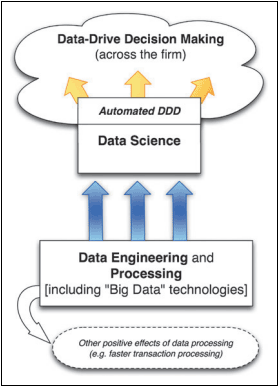
“Data-driven decision making refers to the practice of basing decision on the analysis of data rather than purely on intuition,” say the authors. “The benefits of data-driven decision making have been demonstrated conclusively.”
The authors cite a study conducted by economist Erik Brynjolfsson and his colleagues from MIT and Penn’s Wharton School on how DDD affect firm performance. Using detailed survey data on the business practices and information technology investments of 179 large publicly traded firms, the study concludes that firms that adopt DDD have output and productivity that is 5-6% higher than what would be expected given their other investments and information technology usage.
Provost and Fawcett warn, readers shouldn’t lose sight of the fact that despite the impression that one might get there is a lot to data processing that is not “data science.” The authors define “big data” to mean “datasets that are too large for traditional data-processing systems and that therefore require new technologies” such as Hadoop, Hbase, CouchDB, etc. They further note that Economist Prassanna Tambe of New York University’s Stern School has found that the use of big data technologies correlates with significant additional productivity growth.
“Specifically, one standard deviation higher utilization of big data technologies is associated with 1-3% higher productivity than the average firm,” write Provost and Fawcett. “One standard deviation lower in terms of big data utilization is associated with 1-3% lower productivity.”
This is important to note, say the authors, because they believe that industry followers should expect a Big Data 2.0 phase to follow Big Data 1.0. Once companies are capable of flexibly processing massive data, business managers will start asking “What can I now do that I couldn’t do before, or do better than I could do before?” This paradigm shift, say the authors, will likely usher in a golden era of data science in which the principles and techniques of data science are applied more broadly and deeply than ever before.
In ten years-time, argue Foster and Provost, the predominant technologies will likely have changed or advanced enough that today’s choices would seem quaint. The authors highlight the fact that increasingly, business decisions are being made automatically by computer systems, with some of the early purveyors of large-scale data (finance and telecommunications) being the early adopters of automatic decision-making. They point toward a day when a chief scientist in a data-science-oriented company will do much less data processing and more data analytics design and interpretation.
Data science, conclude the authors, supports data-driven decision making – and sometimes allows making decisions automatically at a massive scale. Thus, the authors argue that it’s important to identify the fundamental principles that underlie data science that have both theoretical and empirical backing.
‘The principles of data science are its own and should be considered and discussed explicitly in order for data science to realize its potential,” conclude the Foster and Provost.
Technologies:
Systems
Sectors:
Academia, Biosciences, Financial Services, Government, Healthcare, Manufacturing, Other, Retail, Science
Leading Solution Providers


Tabor Network


Sponsored Multimedia




Featured Events
-
AI & Big Data Expo North America 2024
 June 5 - June 6Santa Clara CA United States
 -
AI Hardware & Edge AI Summit Europe
 June 18 - June 19London United Kingdom
 -
AI Hardware & Edge AI Summit 2024
 September 10 - September 12San Jose CA United States
 -
CDAO Government 2024
 September 18 - September 19Washington DC United States