


March 27, 2012
Data Exchange Pushes Insourcing
American manufacturing has taken a beating due to outsourcing. Companies, looking to improve their bottom line, have found savings through cheap labor overseas, consequently reducing jobs and hurting the economy.
 Looking to buck the status quo, a new initiative calls on supercomputing and big data to drive manufacturing jobs back to the U.S.
Last June, in a speech at Carnegie Mellon University, President Obama announced a program called Advanced Manufacturing Partnership (AMP), aimed to reinvigorate American manufacturing.
A critical part of AMP is the Materials Genome Initiative (MGI), which the White house refers to as “A Renaissance of American Manufacturing”. The MGI will provide financial support for computational tools and software as well as assist with the creation of open standards and databases.
Many applications used to research new materials are created by different sources. So, much of the knowledge is spread out among various interfaces. It’s almost like each research facility is manufacturing screws with different heads, one makes a flathead while the other makes a hex screw. Both of them are working on the same problem, but their tools are not very compatible. Also, the White House suggests that virtual testing of materials is not being utilized to its potential.
“These computational tools are still not widely used due to industry’s limited confidence in accepting non- empirically-based conclusions. Materials scientists have developed powerful computational tools to predict materials behavior, but these tools have fundamental deficiencies that limit their usefulness.”
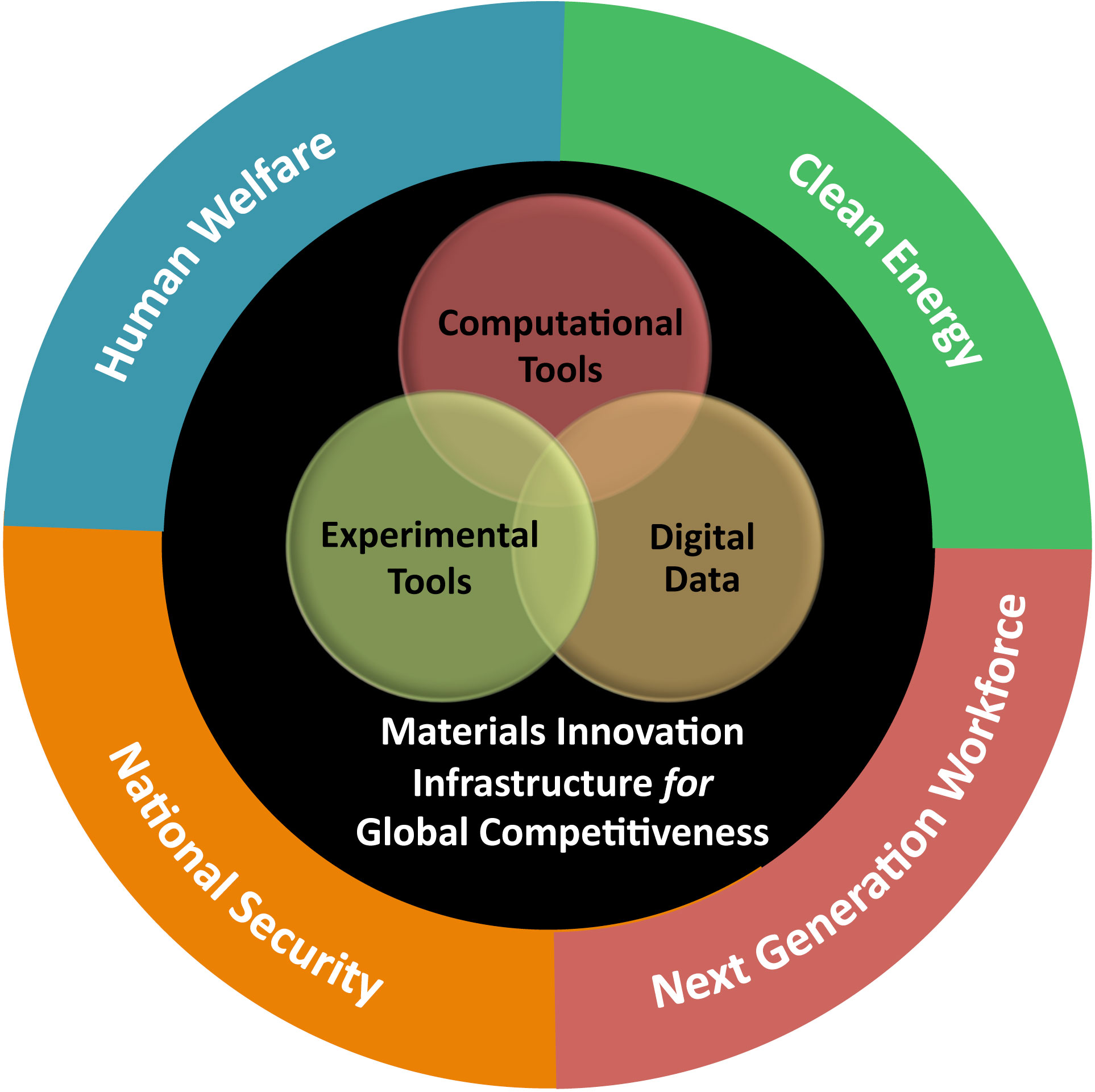
The MGI looks to alleviate these issues with supercomputers and an open data exchange. It describes an outlet that allows researchers to index, search and compare data. Through the creation of such a system, scientists could improve collaborative efforts by providing better feedback from each level of material development. The goal is to promote transparency and integration as a means to accelerate further innovations. ;
Along with increased connectivity and correspondence between research facilities, the program looks to focus on increasing the use of computational resources. Because of advancements in processing power, computerized modeling has now become more attractive to researchers. ;In a recent article (reg. required), Robert F. Service discusses how supercomputers are better at handling the task of modeling
“Crunching the numbers for all the computable properties of a single known material — including crystal structure, stability, and ionic mobility — takes the equivalent of 1 day for a standard computer chip, known as a CPU. To make that calculation for all known inorganic compounds would take between 2 million and 3 million CPU hours, a job one of the most advanced supercomputers could carry out in just a day and a half.”
This is an important advancement, as researchers simply don’t have the time to test every combination of materials. Computer modeling could enhance their ability to focus on compounds that deliver the most promise. ;
Manufacturing has been a common goal in the stormy political climate. However, to make the country more attractive to industry, the cost and production of materials needs to come down. The MGI certainly promotes a competitiveness that could bring an entire outsourced industry back to the United States.
Related Stories
National Program Office for the Advanced Manufacturing Partnership Established at NIST
A Data Commons for the Developing World
Leading Solution Providers


Tabor Network


Sponsored Multimedia





Featured Events
-
Call & Contact Center Expo
 April 24 - April 25Las Vegas NV United States
 -
AI & Big Data Expo North America 2024
 June 5 - June 6Santa Clara CA United States
 -
AI Hardware & Edge AI Summit 2024
 September 10 - September 12San Jose CA United States
 -
CDAO Government 2024
 September 18 - September 19Washington DC United States